Introduction
Poor and erratic fruit set is one of the most consistently reported yield constraints in durian across Southeast Asia, and the underlying cause is largely reproductive biology rather than tree health: durian is substantially self-incompatible and depends on effective pollination within a very short receptive window. This article explains durian flower biology, why natural fruit set is often low, and the pollination management practices supported by peer-reviewed research.
Quick Summary
- Durian is largely self-incompatible; hand cross-pollination has been shown to more than triple fruit set compared with self-pollination in controlled studies.
- The effective pollination period in durian is very short, essentially confined to the single night of anthesis, fruit set drops close to zero once 24 hours have passed.
- Durian flowers open fully in the late afternoon, with anthers dehiscing and stigmas receptive by early evening; most floral parts abscise before or around midnight.
- Natural pollinators historically include nectar-feeding bats, but hand pollination is increasingly used commercially to improve fruit set reliability.
Durian Flower Biology
Durian flowers open fully in the late afternoon, typically between roughly 4:00 and 4:30 pm, with anthers dehiscing (releasing pollen) around 7:30 to 8:00 pm, by which time the stigma is already receptive. Most stamens and petals abscise before midnight, while an unpollinated stigma can persist for three to five days before dropping. This tight, largely nocturnal window is central to why pollination management matters commercially.
The effective pollination period, the window during which pollination reliably results in fruit set, has been shown to be very short: research in Thailand found a mean fruit set of around 50 percent from pollination at anthesis, but fruit set from pollination the following morning ranged from 0 to only 3.4 percent, with no fruit set recorded from pollination 24 or more hours after anthesis.
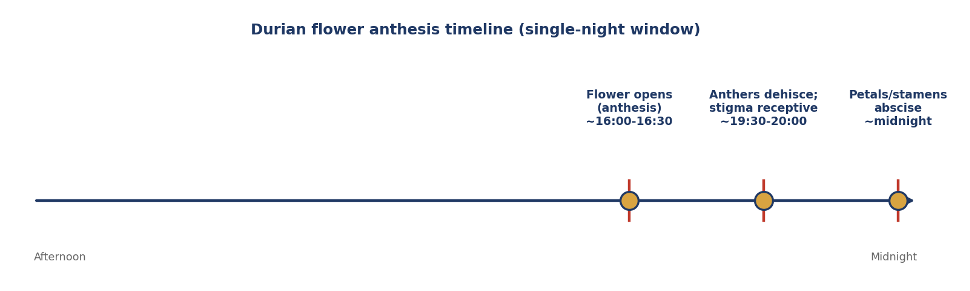
Figure 1. Durian flower anthesis timeline, showing the timing of anther dehiscence and stigma receptivity.
ALT text: Timeline diagram of durian flower anthesis with timing annotations for anther dehiscence and stigma receptivity
Source: Original diagram created in-house based on cited flowering physiology research (Lim & Luders, 1998; Bumrungsri et al., 2009).
Self-Incompatibility and Pollination
Durian exhibits a largely self-incompatible breeding system, described in the literature as gametophytically controlled, with cultivars ranging from totally self-incompatible to partially or, in some cases, fully self-compatible. Self-pollination is associated with higher rates of fruit abortion and produces misshapen fruit with fewer, often shrunken arils and seeds, because unfertilised ovules do not develop a normal aril.
Manually assisted cross-pollination has been shown to substantially improve outcomes: one study recorded 31 percent fruit set from hand cross-pollination against under 10 percent from selfing, while pollination ecology research in southern Thailand recorded fruit set as high as 76.6 percent from hand-crossed pollination compared with 54.4 percent from open (natural) pollination and very low success from facilitated self-pollination. More recent cultivar-specific work on Musang King has recorded fruit set as high as 93 percent where supplementary manual pollination was combined with favourable environmental conditions.
| Pollination Method | Reported Fruit Set Range | Fruit Quality Outcome |
| Self-pollination |
Under 10% (Lim & Luders, 1998); very low in facilitated autogamy trials |
More fruit abortion; misshapen fruit, fewer/smaller arils and seeds |
| Open (natural) pollination | 5.1%–54.4% depending on site and study | Variable, dependent on pollinator activity and weather |
| Hand cross-pollination | 31%–76.6% depending on cultivar and study; up to 93% in Musang King under favourable conditions | Higher yield and better fruit quality reported consistently |
Environmental and Seasonal Factors
Temperature, humidity and photoperiod influence flowering behaviour: elevated temperatures can accelerate floral development, while higher humidity has been observed to extend nectar secretion and potentially alter pollinator activity. Weather-driven variability in flowering and fruiting phenology has also been documented seasonally, underscoring why flowering management practices (nutrient timing, irrigation, and where practical, hand pollination) need to be responsive to seasonal conditions rather than fixed to a single calendar date.
Practical Management Recommendations
- Where labour allows, implement hand cross-pollination during the anthesis window (typically evening) to materially improve fruit set over relying on natural pollinators alone, this is the single most evidence-supported intervention available to growers.
- Support natural pollinators where hand pollination is not practical at scale: nectar-feeding bats are documented natural pollinators of durian in parts of Southeast Asia, and protecting bat roosting habitat near orchards supports this ecosystem service.
- Align nutrient and irrigation management with the pre-flowering stage (see the Fertiliser Programme article) to support flower development, since nutrient timing interacts with flowering physiology.
- Time pollination interventions precisely: given the very short effective pollination period, pollination attempted more than a day after anthesis is unlikely to succeed and effort is better focused on the anthesis evening itself.
Flower and Fruit Thinning
Durian trees typically produce far more flowers than can develop into commercially viable fruit, and thinning excess flowers or young fruit is a standard practice to concentrate the tree's resources on fewer, higher-quality fruit and reduce the risk of later fruit drop (see the Fruit Development article for detail on fruit-stage thinning).
Practical Farm Checklist
| Check | Timing |
| Monitor flower bud development and anticipate anthesis date | Pre-flowering through flowering onset |
| Schedule hand pollination labour for the anthesis evening window | Day of anthesis, evening |
| Adjust nitrogen down, phosphorus/potassium up ahead of flowering | Pre-flowering (see Fertiliser Programme article) |
| Thin excess flowers/young fruit | Early fruit set |
Key Takeaways
- Durian's largely self-incompatible breeding system means natural fruit set is often low and erratic without pollination management.
- The effective pollination period is essentially one night, timing of any hand pollination intervention is critical.
- Hand cross-pollination has repeatedly been shown in peer-reviewed research to substantially outperform self- and open pollination for both fruit set rate and fruit quality.
- Flowering management should be coordinated with nutrient and irrigation timing, not treated as an isolated intervention.
Frequently Asked Questions
Why does my durian tree flower heavily but set little fruit?
This is consistent with durian's largely self-incompatible breeding system, natural self-pollination results in high rates of fruit abortion and misshapen fruit. Hand cross-pollination during the anthesis window has been shown in research to substantially improve fruit set.
What is the effective pollination period in durian?
Research in Thailand found the effective pollination period to be very short, essentially the single night of anthesis. Fruit set dropped to near zero when pollination was attempted 24 or more hours after the flower opened.
Does hand pollination really make a measurable difference?
Yes. Multiple peer-reviewed studies report substantially higher fruit set from hand cross-pollination compared with self- or open pollination, in some studies more than doubling fruit set and improving fruit shape and seed development.
What time of day do durian flowers open?
Durian flowers typically open fully in the late afternoon, with anthers releasing pollen and stigmas becoming receptive by early evening. Most floral parts abscise before midnight.
Do bats really pollinate durian?
Yes, nectar-feeding bats are documented natural pollinators of durian in parts of Southeast Asia, and protecting their roosting habitat is recognised as supporting durian pollination where hand pollination is not practical at scale.
References
Bumrungsri, S., Sripaoraya, E., Chongsiri, T., Sridith, K., & Racey, P. A. (2009). The pollination ecology of durian (Durio zibethinus, Bombacaceae) in southern Thailand. Journal of Tropical Ecology, 25(1), 85–92.
Honsho, C., Yonemori, K., Somsri, S., Subhadrabandhu, S., & Sugiura, A. (2004). Effective pollination period in durian (Durio zibethinus Murr.) and the factors regulating it. Scientia Horticulturae, 111(1), 65–69. https://doi.org/10.1016/j.scienta.2006.09.004
Lim, T. K., & Luders, L. (1998). Durian flowering, pollination and incompatibility studies. Annals of Applied Biology, 132(1), 151–165. https://doi.org/10.1111/j.1744-7348.1998.tb05192.x
Nguyen, V. T., et al. (2025). Investigation of biological characteristics of fruit development and physiological disorders of Musang King durian (Durio zibethinus Murr.). Open Agriculture, 10(1). https://doi.org/10.1515/opag-2025-0422