Introduction
Durian is a climacteric fruit with a naturally short shelf life at ambient temperature, and postharvest losses are shaped as much by handling and storage decisions as by field practices. This article covers fresh-fruit storage, chilling injury avoidance, controlled atmosphere options, and the cold chain requirements now standard for frozen export, which has become an increasingly important channel for durian trade into China.
Quick Summary
- Fresh durian harvested before natural drop typically ripens within four to six days at ambient temperature.
- Controlled atmosphere storage (3–5% O2, 5–15% CO2) at 14°C has been shown to extend postharvest life to around eight weeks, compared with roughly five weeks in ordinary air at the same temperature.
- Durian is chilling-sensitive: all cultivars are damaged by storage at 5°C for one week or 10°C for two weeks, with symptoms including surface discoloration and failure to properly ripen.
- Frozen whole durian for export to China is stored and transported at -18°C, with a shelf life of 18 to 24 months, a channel that has grown significantly as a way to manage seasonal surplus and extend market access.
From Harvest to Packing House
Postharvest handling begins at the point of harvest: fruit should be harvested to avoid soil contact and impact damage (see the Harvesting article), since both increase susceptibility to postharvest disease, particularly Phytophthora and associated fungal fruit rot (see the Diseases article). In the packing house, fruit is sorted, graded and cleaned, and grouped by variety, size, maturity and freedom from defects to meet local or export market specifications.
Storage Temperature and Chilling Injury
Durian is notably chilling-sensitive, a characteristic shared with many tropical fruits. Documented chilling injury symptoms include black discoloration of the fruit surface, particularly in the grooves between spines, and a loss of the fruit's ability to convert starch to sugars, meaning affected fruit fails to ripen properly even if it survives storage. All durian cultivars are damaged by storage at 5°C for as little as one week, or 10°C for two weeks, which sets a hard floor on how cold fresh (unfrozen) durian can safely be kept.
Within the safe range, moderate cool storage around 14°C in a controlled atmosphere of 3 to 5 percent oxygen and 5 to 15 percent carbon dioxide has been shown to reduce respiration and ethylene production, meaningfully slowing ripening and extending postharvest life to around eight weeks, compared with roughly five weeks for fruit held in ordinary air at the same temperature.
| Storage Condition | Approximate Outcome |
|
Ambient temperature (harvested before natural drop) |
Ripens naturally in 4–6 days |
| 14°C, ordinary air | Approximately 5 weeks postharvest life |
| 14°C, controlled atmosphere (3–5% O2, 5–15% CO2) | Approximately 8 weeks postharvest life |
| 5°C for 1 week, or 10°C for 2 weeks | Chilling injury: surface discoloration, failure to ripen |
| -18°C (frozen, IQF or whole) | 18–24 months shelf life, standard for frozen export |
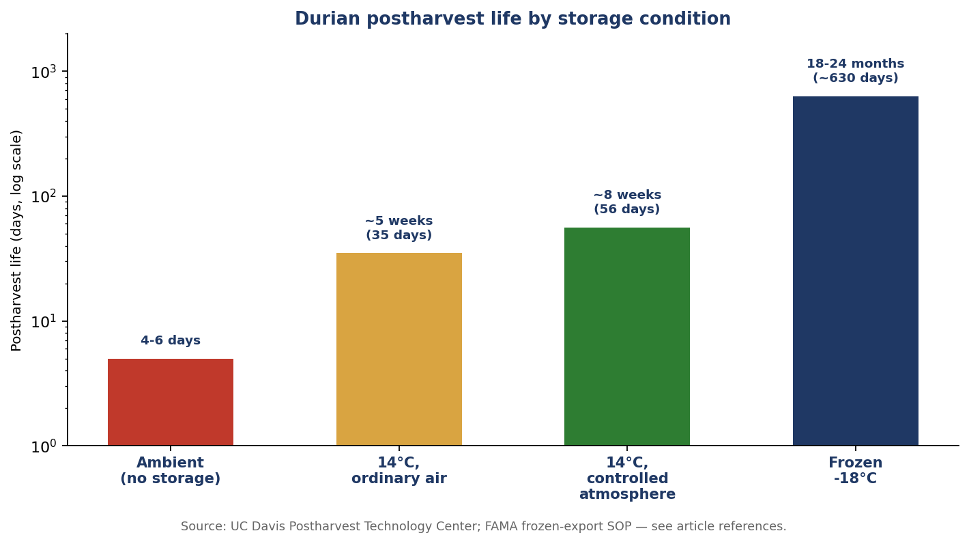
Figure 1. Durian postharvest life by storage condition, from ambient to frozen export.
ALT text: Bar chart comparing durian postharvest life in days across ambient, 14°C air, 14°C controlled atmosphere and frozen -18°C storage
Source: Durian Doctor original chart, built from the cited UC Davis and FAMA data.
Fresh Export Handling
Fresh durian export requires careful maturity control combined with temperature management, since the fruit continues to ripen after harvest and is sensitive to both chilling injury at the low end and rapid over-ripening if held too warm. Common industry guidance favours transporting mature but unripe fruit under managed temperatures, often in the low-to-mid teens Celsius, with some supply chains layering in controlled atmosphere transport to further slow ripening and extend marketable life during transit.
Frozen Export: A Growing Channel
Frozen whole durian and Individual Quick Frozen (IQF) durian segments have become an increasingly significant export format, particularly into China, because freezing removes the shelf-life constraint that limits fresh export and allows surplus from the main harvest season to be supplied through the off-season. Freezing also reduces microbial growth, extending food safety margins, and IQF processing in particular helps preserve flavour and texture by freezing segments individually rather than as a single mass.
Standard operating procedure for frozen whole durian export to China specifies storage and transit temperature maintained at -18°C with continuous temperature monitoring through the journey, and a resulting shelf life in the range of 18 to 24 months. Exporters should confirm current documentation and inspection requirements with the relevant national plant protection authority, since import protocols and registered grower/packing facility approval processes are administered government-to-government and can change.
Practical Farm and Packing House Checklist
| Check | Timing |
| Avoid fruit-to-soil contact and impact damage at harvest |
At harvest |
| Sort and grade by variety, size, maturity and defect status | At packing house intake |
| Maintain fresh fruit storage above chilling injury thresholds (avoid 5°C/1 week or 10°C/2 weeks) | Throughout storage and transport |
| Confirm current export protocol and documentation requirements with relevant plant protection authority | Before each export shipment |
| Monitor cold chain temperature continuously for frozen export | Throughout transit |
Key Takeaways
- Durian's chilling sensitivity sets a hard lower temperature limit for fresh storage, below which fruit is damaged and fails to ripen properly.
- Controlled atmosphere storage meaningfully extends fresh postharvest life within the safe temperature range.
- Frozen export at -18°C has become a major channel for durian trade, offering a much longer shelf life than any fresh storage method.
- Reducing fruit-to-soil contact and impact damage at harvest has a direct, documented effect on postharvest disease incidence.
Frequently Asked Questions
How long does fresh durian last after harvest?
Fruit harvested before natural drop typically ripens within four to six days at ambient temperature. Under controlled atmosphere storage at 14°C, postharvest life can be extended to around eight weeks, compared with about five weeks in ordinary air at the same temperature.
Can durian be refrigerated like other fruit?
Not at typical refrigerator temperatures. Durian is chilling-sensitive, all cultivars are damaged by storage at 5°C for one week or 10°C for two weeks, resulting in surface discoloration and failure to ripen properly. Moderate cool storage around 14°C is the safer range for fresh fruit.
What is the shelf life of frozen durian for export?
Frozen whole durian exported at -18°C with continuous cold chain monitoring is typically rated for an 18 to 24 month shelf life, which is why frozen export has become an important channel for managing seasonal surplus.
Why does soil contact during harvest matter for storage life?
Fruit that contacts soil during harvest has been directly linked to higher postharvest disease incidence and severity, particularly Phytophthora-related fruit rot, which shortens effective storage and shelf life regardless of temperature management.
What temperature should durian be transported at for fresh export?
Industry guidance commonly favours managed temperatures in the low-to-mid teens Celsius for mature, unripe fruit in transit, balancing the need to slow ripening against the risk of chilling injury at lower temperatures.
References
3W Logistics. (2026). Procedures for export durian to China in 2026. [Industry logistics guidance].
Safarim, S., Razali, N. A., Ibrahim, W. M. W., & Rahim, M. S. A. (2021). From farm to China: A case study of Malaysian frozen whole durian export supply chain. [Economic/supply chain study].
The standard operating procedure (SOP) for exporting frozen whole durian fruit to the Republic of China. (2023). [Malaysian Federal Agricultural Marketing Authority (FAMA) technical document].
University of California, Davis, Postharvest Research and Extension Center. (n.d.). Durian: Produce facts. UC Davis Postharvest Technology Center. https://postharvest.ucdavis.edu/produce-facts-sheets/durian