Introduction
Determining the right harvest window is one of the most consequential decisions a durian grower makes, immature fruit never develops proper flavour and texture after picking, while overripe fruit that drops naturally is prone to damage and has a very short remaining shelf life. Unlike many fruit crops, durian has historically lacked a single definitive harvest index, which is why growers and researchers use several indicators together rather than relying on any one signal alone.
Quick Summary
- Days after anthesis (DAA), also referred to as days after full bloom (DAFB), is the most consistently used objective timing reference across durian maturity research.
- For 'Monthong', fruit reaches maximum size by around 90 days after full bloom, while total soluble solids continue rising toward 135 days, illustrating the trade-off between size, firmness and sweetness at different harvest windows.
- Ease of fruit abscission, how readily the stalk separates, is a recognised maturity index; fully mature fruit eventually drops naturally.
- Multi-parameter approaches combining DAA, total soluble solids, dry matter content and even near-infrared spectroscopy of the spine or stem are active areas of research aimed at replacing purely visual judgement with more objective maturity prediction.
Maturity Indicators
| Indicator | What to Look For | Notes |
| Days after anthesis (DAA) | Count from flower full bloom/anthesis date; typical harvest window for many cultivars falls in the range of roughly 90 to 135 days depending on variety and market target | Most objective reference point, requires flower tagging or orchard records |
| Fruit stalk (peduncle) | Natural partial breaking/abscission at the stalk's abscission zone |
Recognised as a maturity index; can be assessed without cutting the fruit |
| Spine (thorn) appearance | Tip of thorns drying and turning dark brown; spines becoming more widely spaced as fruit reaches full size | Used alongside stalk and colour indicators by experienced harvesters |
| Shell/rind colour | Shifts from dull olive-green toward a lighter yellowish-green as maturity progresses | Colour-based classification has been validated instrumentally for 'Monthong' using spine and rind spectral analysis |
| Seam definition |
Fruit seams (sutures between locules) become more clearly visible |
Supporting visual cue, used together with other indicators |
| Aroma |
Distinct durian aroma becomes noticeable, often within a day or two of maturity being reached |
More reliable close to full maturity than earlier in development |
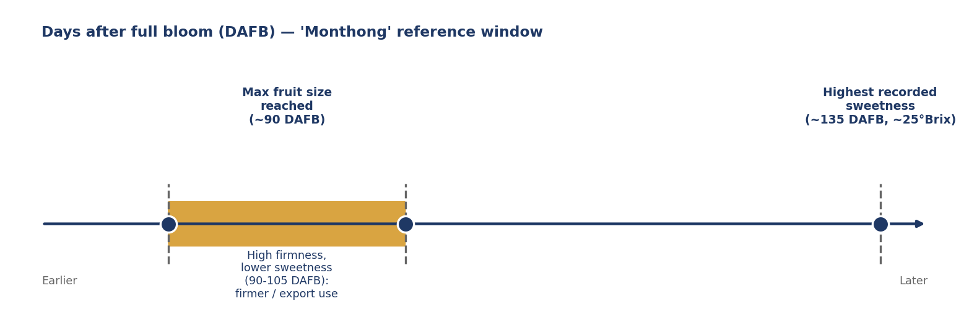
Figure 1. Harvest maturity window guide for 'Monthong' durian, days after full bloom.
ALT text: Diagram showing 'Monthong' durian harvest windows for maximum size, firmness-focused and peak-sweetness harvest by days after full bloom
Source: Durian Doctor original illustration, based on cited maturity research.
The Size, Firmness and Sweetness Trade-Off
Research on 'Monthong' durian tracked fruit at 15-day intervals from 15 to 135 days after full bloom and found that fruit reached maximum size at around 90 days after full bloom, while fruit harvested at 90 to 105 days after full bloom showed high firmness but low sweetness, better suited to markets prioritising texture and transport durability over immediate eating quality. Total soluble solids continued increasing through to 135 days after full bloom, where the highest sugar content in the study, 25 degrees Brix, was recorded.
This size/firmness/sweetness trade-off is precisely why harvest timing needs to be matched to the intended market and transport duration, fruit destined for distant export markets is sometimes harvested slightly earlier to withstand handling, while fruit for immediate local sale can be timed closer to full ripeness indicators.
Objective Maturity Measurement
Because a large proportion of exported Thai durian has historically been found to be immature at the point of sale, considerable research effort has gone into more objective, non-destructive maturity classification. Visible and near-infrared spectroscopy of the durian spine and stem, measuring the absorbance signatures of chlorophyll, carotenoids and anthocyanins, has achieved classification accuracy above 94 percent into maturity classes spanning roughly 113 to 134 days after anthesis in controlled studies, and combined multi-parameter indices using DAA, total soluble solids and dry matter content are an active area of development for miniature, field-deployable spectrometers.
Harvesting Technique
- Harvest by hand-cutting the stalk rather than allowing fruit to drop naturally where fruit quality and marketability are priorities; naturally dropped fruit is prone to impact damage and bruising and reduces remaining shelf life.
- Avoid fruit contact with soil during harvest and immediately after, since soil contact has been directly linked to higher postharvest disease incidence and severity (see the Diseases article).
- Handle harvested fruit carefully to avoid bruising the husk, since impact damage creates entry points for postharvest pathogens.
- Record the harvest date and, where flower tagging is practised, the corresponding days-after-anthesis figure for each block, supporting a feedback loop that improves timing accuracy over successive seasons.
Practical Farm Checklist
| Check |
Timing |
| Tag flowers at full bloom to enable DAA tracking | At flowering (see Flowering Management article) |
| Begin monitoring stalk, spine and colour indicators |
From approximately 90 days after anthesis |
| Cross-check indicators against target market (firmness vs. sweetness priority) | Approaching harvest window |
| Hand-cut rather than allow natural drop where fruit quality is a priority |
At harvest |
| Avoid fruit-to-soil contact during and after harvest | At harvest and handling |
Key Takeaways
- No single indicator reliably determines durian maturity on its own; days after anthesis combined with stalk, spine and colour observation gives the most reliable field assessment.
- Harvest timing involves a genuine trade-off between fruit size, firmness and sweetness, match timing to the intended market.
- Objective, instrument-based maturity classification is increasingly available and can materially reduce the risk of harvesting immature fruit.
- Hand-harvesting and careful handling reduce postharvest disease risk compared with fruit left to drop naturally.
Frequently Asked Questions
How many days after flowering should durian be harvested?
This varies by cultivar and target market, but research on 'Monthong' found fruit reached maximum size around 90 days after full bloom, with sweetness (total soluble solids) continuing to rise up to at least 135 days. Days after anthesis is the most commonly used objective reference point, best combined with stalk, spine and colour indicators.
What does it mean if the durian stalk is starting to separate?
Natural partial breaking or abscission at the fruit stalk is a recognised maturity indicator in durian, it typically appears as the fruit approaches full maturity, alongside spine colour change and shell colour shift.
Should I let durian fruit drop naturally or cut it?
For fruit quality and marketability, hand-cutting at the appropriate maturity window is generally preferable to allowing natural drop, since dropped fruit is prone to impact damage and has reduced remaining shelf life.
Why is durian maturity so hard to judge accurately?
Durian has historically lacked a single definitive maturity index, and a significant proportion of fruit harvested for export has been found to be immature. This is why researchers use combined indicators, and increasingly instrument-based methods like near-infrared spectroscopy, rather than relying on any single visual cue.
Does harvesting durian earlier or later change the taste?
Yes. Research shows a trade-off: fruit harvested earlier in the maturity window tends to be firmer but less sweet, while later-harvested fruit has higher sugar content but less firmness for transport. Harvest timing should be matched to your target market's priorities.
References
Kasemsumran, S., et al. (2012). Non-destructive classification of durian maturity of 'Monthong' cultivar by means of visible spectroscopy of the spine. Journal of Food Engineering. https://doi.org/10.1016/j.jfoodeng.2012.04.007
Model for evaluation of maturity index of durian fruit (Durio zibethinus Murray 'Monthong'). (2005). [Peer-reviewed study, Thailand].
Multi-parameter index for durian maturity and its prediction using miniature near infrared spectrometer. (2023). Postharvest Biology and Technology / related journal. https://doi.org/10.1016/j.postharvbio.2023.xxxxx
Rajamangala University of Technology Tawan-Ok. (2021). Assessment of natural fruit ripening and fruit quality of 'Monthong' durian. Thailand Institute of Scientific and Technological Research.
University of California, Davis, Postharvest Research and Extension Center. (n.d.). Durian: Produce facts. UC Davis Postharvest Technology Center. https://postharvest.ucdavis.edu/produce-facts-sheets/durian