Introduction
Insect pests are one of the two major biological constraints on durian yield, alongside disease. Unlike diseases, most durian pests can be observed directly, feeding damage, frass, webbing or the insects themselves, which makes early scouting one of the most cost-effective interventions available to a grower.
This article covers the fruit and shoot borer complex, which is consistently reported as the most damaging insect pest group in surveyed durian orchards, together with mealybugs and other secondary pests, and sets out an integrated pest management (IPM) approach consistent with responsible-use principles.
Quick Summary
- The fruit/shoot borer Conogethes punctiferalis is widely reported as the most serious durian insect pest across Malaysia, the Philippines and Thailand (Ithnin et al., cited in Basri, 2018; Evangelista, cited in UPLB thesis record).
- In surveyed Philippine orchards, borer infestation reduced yield significantly, and combined insecticide plus fruit-bagging programmes reduced infestation from roughly 47 percent to under 9 percent in trial data.
- Fruit bagging and thinning are consistently identified as effective, low-chemical-input tools because single, bagged fruit are less attractive to egg-laying moths (Basri, 2018).
- Mealybugs and other sap-feeding pests are best managed by protecting natural enemies (ladybird beetles, parasitic wasps) and controlling ants, which shield mealybugs from predation.
The Durian Fruit and Shoot Borer Complex
The most economically important insect pest of durian across Southeast Asia is Conogethes punctiferalis (Lepidoptera: Crambidae), commonly called the durian fruit or husk borer. In parts of the southern Philippines it occurs alongside a second borer species, Tonica lagaropis, and infestation levels of 6.6 to nearly 32 percent have been recorded depending on locality, season and durian clone.
Larvae of C. punctiferalis feed on floral buds, flowers, and young to mature fruit, and infestation can begin as early as one to two weeks after fruit set, marked by masses of fecal material lodged between the fruit spines. T. lagaropis larvae feed on the skin surface and internal locules, leaving characteristic reddish frass on the husk.
| Pest | Damage Pattern | Peak Activity |
| Conogethes punctiferalis (fruit/husk borer) | Fecal material between fruit spines from 1–2 weeks after fruit set; feeds on buds, flowers, young and mature fruit; 2–3 generations per fruiting season | Coincides with the harvest peak in surveyed regions |
| Tonica lagaropis (durian ecophorid borer) | Reddish frass on the fruit skin; larvae feed on the skin surface and internal locules; serious infestation typically 3–5 weeks after fruit set |
Localised to parts of the Philippines |
|
Mealybugs (Planococcus spp., Pseudococcus spp.) |
Waxy white sap-feeding colonies on shoots, flowers and fruit; honeydew and associated sooty mould | Warm, dry periods; populations protected and spread by attending ants |
Integrated Pest Management: Cultural, Physical, Biological and Chemical
Trial data from a Thai durian orchard comparing insecticide-plus-bagging combinations against farmer standard practice demonstrates that IPM combinations, rather than insecticide alone, deliver the most consistent borer control. Separately, field trials in the Philippines recorded borer infestation reduced from 47.4 percent in untreated blocks to 6.7 and 8.1 percent respectively under two insecticide programmes timed from three weeks after fruit set, with corresponding yield increases.
- Fruit bagging and thinning: single, bagged fruit are markedly less attractive to egg-laying Conogethes moths, and bagging can reduce the need for insecticide applications where it is practical at scale.
- Orchard sanitation and intercropping management: reducing alternate host plants and removing fallen infested fruit lowers carry-over populations between fruiting seasons.
- Monitoring: pheromone-based monitoring for Conogethes is under active development in the region and, where commercially available, supports better-timed spray decisions than calendar spraying.
- Biological control: natural enemies of borers (parasitic braconid wasps, predatory earwigs) and of mealybugs (predatory beetles such as Cryptolaemus montrouzieri, parasitic Leptomastix wasps) contribute meaningfully to suppression when not disrupted by broad-spectrum insecticide use.
- Ant control: because ants protect mealybugs from natural enemies in exchange for honeydew, managing ant activity around infested trees is a recognised lever for improving biological control outcomes.
- Chemical control: where an insecticide can be recommended for use in durian farming in your market, timing matters more than product choice alone, applications timed from early fruit set through the vulnerable window materially outperform later or untimed spraying; always follow the current product label for rate and pre-harvest interval.
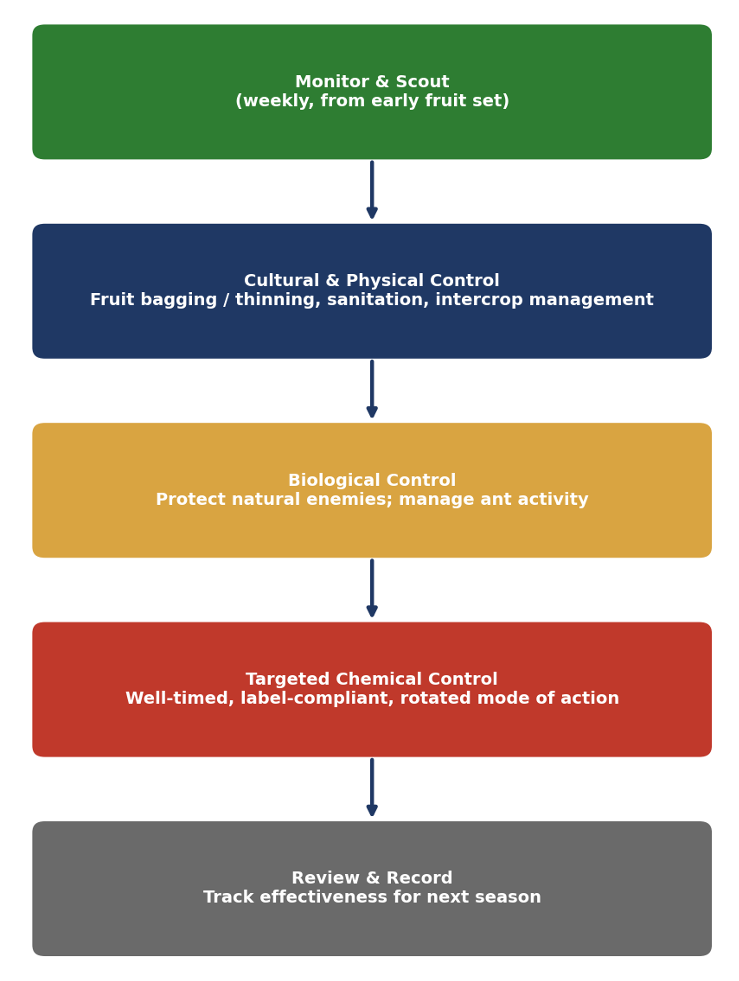
Figure 1. IPM decision hierarchy for durian fruit borer, from monitoring through to chemical control.
ALT text: Flowchart showing monitoring, cultural, biological and chemical control steps for durian fruit borer IPM
Source: Original diagram created in-house based on cited literature.
Mealybugs and Other Secondary Pests
Mealybugs, scale insects, psyllids and leaf-eating beetles are also recorded on durian, generally as secondary rather than primary yield-limiting pests, though heavy mealybug infestation can reduce fruit quality through honeydew and associated sooty mould. General entomological guidance on mealybug biology indicates that avoiding broad-spectrum, persistent insecticide use preserves the predatory and parasitic natural enemies that otherwise keep mealybug populations below damaging levels.
Diagnosis: Distinguishing Pest Damage from Disease or Physiological Disorders
- Frass or webbing at the damage site points to an insect cause; a lesion without frass, webbing or an insect present is more likely disease or a nutrient/physiological disorder (see the Durian Doctor Diseases and Nutrient Disorders articles).
- Borer damage typically originates at a discrete entry point with visible fecal material; fruit cracking disorders instead show a clean split without associated frass.
- Sooty mould on leaves or fruit usually indicates an underlying sap-feeding pest (mealybug, scale, aphid) rather than a fungal leaf disease in its own right.
Practical Farm Checklist
| Check | Frequency |
| Scout fruit for frass/spine damage from 1–2 weeks after fruit set | Weekly through fruit development |
| Inspect for mealybug colonies on new flush and flowers | Fortnightly |
| Check for ant trails on trunks (mealybug indicator) | Fortnightly |
| Bag or thin fruit where practical | At early fruit set |
| Remove and destroy fallen infested fruit | Ongoing |
Key Takeaways
- Conogethes punctiferalis is the priority pest to scout for from early fruit set onward in most durian-growing regions.
- Combining fruit bagging or thinning with well-timed, targeted insecticide use consistently outperforms insecticide-only or bagging-only programmes in published trials.
- Protecting natural enemies by limiting broad-spectrum spraying and managing ants materially improves control of secondary sap-feeding pests such as mealybugs.
- Any chemical control must be checked against the current product label and local registration status for your market.
Frequently Asked Questions
Which pests attack durian fruit?
The most significant fruit-damaging pests are borers, principally Conogethes punctiferalis and, in parts of the Philippines, Tonica lagaropis, which feed inside the developing fruit from early fruit set. Mealybugs and scale insects also affect fruit quality through sap feeding and associated sooty mould.
Does fruit bagging really reduce borer damage?
Yes. Research from Malaysia and Thailand indicates single, bagged fruit are less attractive to egg-laying borer moths, and bagging combined with well-timed insecticide use has outperformed insecticide alone in trial comparisons.
What is the role of beneficial insects in durian pest management?
Parasitic wasps and predatory insects naturally suppress both borer and mealybug populations. Avoiding unnecessary broad-spectrum insecticide applications helps preserve these natural enemies as part of an integrated programme.
How can I tell borer damage from disease damage on fruit?
Borer damage is typically associated with visible frass (fecal material) at the entry point and a discrete feeding tunnel, whereas disease lesions expand as discoloured, often water-soaked patches without frass.
Why are ants a concern in durian pest management?
Ants protect mealybugs and other honeydew-producing pests from their natural predators and parasitoids in exchange for the honeydew, which can allow mealybug populations to increase. Managing ant activity supports better biological control of mealybugs.
References
Basri, M. W. (2018). Status and management of Conogethes spp. in Malaysia. [Conference paper / research report].
Evangelista, R. (1995). Biology, ecology and control of the durian fruit borers, Tonica lagaropis Meyrick (Oecophoridae) and Conogethes punctiferalis (Guenee) (Pyralidae) [Master's thesis]. University of the Philippines Los Baños.
Recent Science and Technology Journal. (2025). Effect of combination between insecticide and fruit bagging for the control of durian fruit borer, Conogethes punctiferalis Guenée (Lepidoptera: Crambidae). Recent Science and Technology, article record.
Singh, S., et al. (2018). The shoot and fruit borer, Conogethes punctiferalis (Guenée): An important pest of tropical and subtropical fruit crops. [Book chapter / review].
University of California Statewide Integrated Pest Management Program. (n.d.). Mealybugs: Pest management guidelines. UC IPM. https://ipm.ucanr.edu/PMG/PESTNOTES/pn74174.html